| .github/workflows | ||
| docs | ||
| exports | ||
| mappings | ||
| packaging | ||
| src/nte_history_exporter | ||
| tests | ||
| tools | ||
| .gitignore | ||
| pyproject.toml | ||
| README.md | ||
| run-exporter.cmd | ||
| run-exporter.ps1 | ||


NTE History Exporter
Prototype CLI exporter for Neverness to Everness pull history — decodes your own game traffic into sanitized JSON ready for tracker import.



Supported Banners
| System | Banner | Banner ID | Pity pool |
|---|---|---|---|
| Monopoly | Standard Board | Lottery_Permanent |
Per-banner |
| Monopoly | Limited Character Board | Lottery_LimitedCharacter |
Shared |
| Gashapon | Arc Miracle Box | Arc_MiracleBox |
Shared |
| Gashapon | Mystery Box | Gashapon_MysteryBox |
Per-rotation |
What It Does
The exporter decodes Permanent Board, Limited Character Board, Arc Miracle Box, and Mystery Box history pages from captured UDP data, applies conservative timestamp-boundary handling, and writes sanitized JSON suitable for tracker import.
Note
The import JSON contains decoded history rows and the shareable NTE user UID when it can be detected. It does not export tokens, account IDs, role IDs, device IDs, server IPs, raw packets, cookies, session data, or other capture metadata.
Requirements
- Python 3.10 or newer when running from source. Release binaries include the Python runtime.
- Packet-capture permission. On Windows, Npcap can usually capture without running this tool as Administrator; the raw-socket fallback may need Administrator. On Linux and macOS, use root or capture capabilities as required by your system.
- Windows: Npcap is recommended. Install it normally; WinPcap API-compatible mode is not required. If Npcap is unavailable or cannot be initialized,
autofalls back to the Windows built-in raw-socket backend. - Linux: install the system libpcap runtime if it is not already present. Package names commonly include
libpcap0.8on Debian/Ubuntu andlibpcapon Fedora, Arch, and similar distributions. - macOS: the system normally includes libpcap, so no separate Npcap installation is needed.
Npcap is Windows-only and is not bundled with this project. Linux and macOS use libpcap, the cross-platform capture library on which Npcap is based.
Downloads
Compiled command-line builds are published on the GitHub Releases page:
nte-history-exporter.exefor Windowsnte-history-exporter-linuxfor Linuxnte-history-exporter-macosfor macOS- Versioned
.ziparchives for each platform
The Windows executable is a single console app. Start it from a terminal:
.\nte-history-exporter.exe
On Linux and macOS, make the downloaded binary executable before running it. Use sudo only when your system requires elevated capture permission:
chmod +x ./nte-history-exporter-linux
sudo ./nte-history-exporter-linux
Use nte-history-exporter-macos in the same way on macOS. If your browser or OS blocks a downloaded macOS binary, allow it from the system security prompt before running it again.
Usage
Live capture
The default auto capture backend uses:
- Windows: Npcap when installed, with automatic fallback to the built-in Windows raw-socket backend.
- Linux/macOS: the system libpcap library.
Use --capture-backend libpcap to require Npcap/libpcap without fallback, or --capture-backend raw to require the Windows raw-socket backend.
Windows
Downloaded executable:
.\nte-history-exporter.exe
From source:
.\run-exporter.ps1
Or simply double-click run-exporter.cmd.
Important
For automatic user UID and account-server detection, launch the tool before pressing Start on the game's main menu. If you are already in game, history capture can still work; the tool will ask for missing account details before saving.
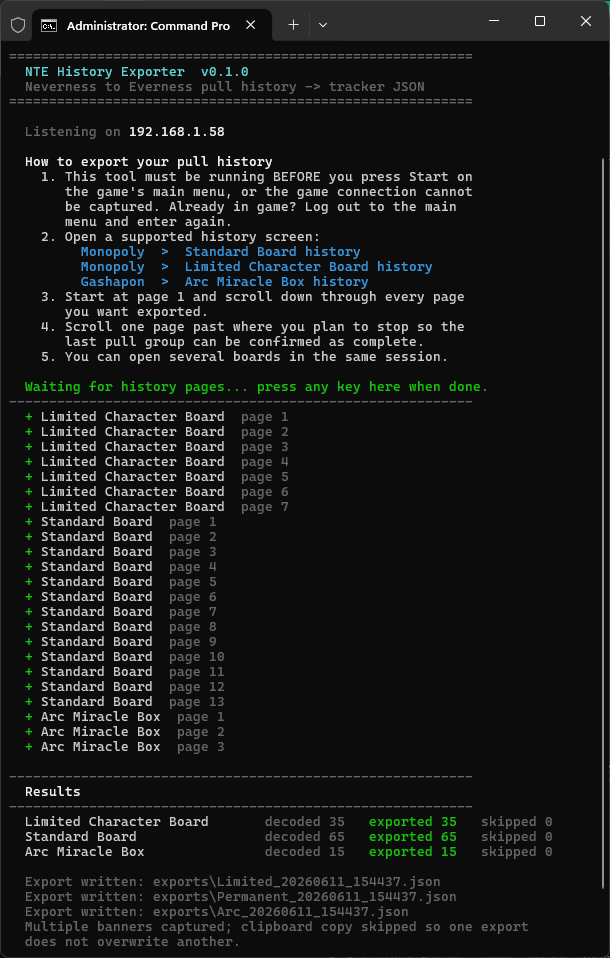
Once running, open any supported history board in game. The tool keeps listening until you press any key. After it prints and saves the results, press any key again to close the exporter. Exports are written under exports\ as:
<user_uid>_Permanent_<date_time>.json<user_uid>_Limited_<date_time>.json<user_uid>_Arc_<date_time>.json<user_uid>_MysteryBox_<date_time>.json
If the user UID is not detected automatically, the console asks for it before saving. Leaving it blank saves as unknown_<banner>_<date_time>.json, but may prevent import on some trackers.
The export also includes server_id and account_region when known. If the
initial TCP server-selection response was missed, the console offers Asia,
America, Europe, and SEA as a numbered choice. The prompt can be left blank to
omit server information.
Exports are not copied to the clipboard by default. Add --copy-clipboard to copy a single captured banner's JSON after saving. If multiple banners are captured in the same run, clipboard copy is skipped so one banner does not overwrite another.
If a page response is missed, the exporter reports the missing page number while capture is still running. Leave the exporter open, close and reopen that history board, then scroll down again. Scrolling backward within the existing view does not request the cached pages again. The replacement capture is accepted and the tool confirms when the gap has been recovered. If reopening the board still produces no page messages, return to the main menu and re-enter the game to start a fresh connection.
Linux/macOS
Downloaded executable, using sudo when your system requires elevated capture permission:
chmod +x ./nte-history-exporter-linux
sudo ./nte-history-exporter-linux
From source, install the project and ensure the system libpcap runtime is available:
python3 -m venv .venv
source .venv/bin/activate
python -m pip install -e .
sudo .venv/bin/nte-history-exporter
macOS normally includes libpcap. On Linux, install the distribution's libpcap runtime package if it is not already present. Capture can also be granted through platform-specific capabilities instead of running the whole exporter with sudo.
File replay
Downloaded executable:
.\nte-history-exporter.exe capture.flows
From source:
.\run-exporter.ps1 capture.flows
Decodes a mitmproxy .flows capture instead of listening live — used for research and testing.
Options
| Flag | Effect |
|---|---|
--live |
Capture live UDP traffic instead of reading a file. |
--debug |
Also write the research CSV and privacy-safe capture diagnostics. |
--user-uid <uid> |
Override the auto-detected NTE user UID in the JSON export. |
--copy-clipboard |
Copy a single live export JSON to clipboard after saving. |
Advanced live-capture selection:
--capture-backend auto      Prefer Npcap/libpcap; fall back to raw sockets on Windows
--capture-backend libpcap   Require Npcap on Windows or libpcap on Linux/macOS
--capture-backend raw       Require the Windows raw-socket backend
The --debug CSV holds decoded research fields, including raw captured history
records. A separate versioned *.diagnostics.json sidecar provides shareable
reason codes and counts without payloads, network addresses, ports, packet
timestamps, or user UID values. See Capture diagnostics.
The exporter automatically includes the shareable NTE user UID when it appears in the capture. If a short capture does not include it, the console asks before saving; you can also pass it explicitly with --user-uid.
Tip
For reliable deduplication, start from page 1 and scroll through the pages. If you only want pages 1–5, scroll through to page 6 as well just to be on the safe side.
Mapping maintenance
Reward metadata can be rebuilt directly from the latest NTE_Assets tables and English translation files. The reward snapshot may change IDs while UID inputs remain untouched:
Run Update reward mappings from the GitHub Actions tab to generate and test the snapshot in a reviewable pull request, or run it locally:
python tools/update_mappings.py
This rebuilds reviewable reward-map candidates directly from NTE_Assets under
build/mapping-update/; committed mappings are untouched unless --apply is
explicitly supplied. The snapshot may include additions, updates, and removals,
while pool mappings and UID inputs remain untouched. See
Reward mapping updates for the source rules and
review workflow.
Privacy
Caution
Sanitized exports are intended for tracker import and should not contain anything especially harmful, but they can identify the game account via user UID and pull history. Share exports only with verified sources, such as known trackers. Do not commit packet captures, generated exports, research briefs, or personal account data. The repository keeps
exports/as an empty output folder but ignores everything generated inside it.
Boundary Policy
NTE history records do not appear to contain a unique server-side roll ID. UIDs are generated from decoded record fields and the record's order within all rows sharing the same raw timestamp.
History always loads page 1 first and is scrolled downward, so the exporter anchors to the continuous run of pages starting at page 1 and ignores anything after the first gap (with a warning). This keeps the newest pages even if a later page is lost, and guarantees the newest timestamp group's ordinal 0 is captured.
Within a timestamp group, ordinal 0 is the newest record and unseen rows can only append after the captured ones, so every exported UID is stable — including a partially captured oldest 10-pull. All decoded rows are therefore exported. Re-scanning later simply adds any rows that were not yet captured, with the same UIDs for the rows already seen.
For Monopoly, Points Gift and Chase Reward rows stay in the timestamp group for UID ordinal generation, but only result_type = dice rows count toward pull-set sizing. Arc pulls are always 10-pulls. Mystery Box records are single pulls and the final page may contain fewer than five records. Every captured group is exported, including an incomplete oldest pull set, because its captured prefix is ordinal-stable.
Adapters
Current
- Live Npcap/libpcap capture on Windows, Linux, and macOS
- Live Windows raw-socket fallback
mitmproxy .flowsresearch decoder
Planned
- Optional pktmon diagnostics for capture-drop investigation
- UI wrapper around the CLI
Example Run